Residential vs Commercial Demolition
Share this article:
A property owner planning a teardown usually starts with one question: is this a residential job or a commercial one? The answer shapes nearly everything that follows. It determines which permits apply, how much insurance the contractor carries, how long the notification window runs, and who is qualified to remove the asbestos behind the walls.
The line is also blurrier than most people expect. A single house can come under federal asbestos rules once it’s cleared alongside other houses or for a commercial project. In Chicago, a mixed-use building is charged the highest applicable environmental fee. Classifying the project correctly at the start keeps the budget and schedule realistic.

How Residential and Commercial Demolition Differ
Most people sort demolition by building type, with houses on one side and offices, schools, and warehouses on the other. Regulators draw the line more precisely. Federal asbestos rules cover commercial, public, industrial, and residential buildings, excluding only residential buildings with four or fewer dwelling units. That threshold determines which notifications, inspections, and work practices apply to a project.
From there, the two categories split along four practical lines: the permits a job triggers, the license and insurance a contractor holds, the hazardous materials removed before equipment arrives, and the number of parties coordinating the schedule.
What Does Residential Demolition Involve?
A typical single-family teardown runs through one municipality. The owner or contractor files the demolition permit, collects disconnect letters from the gas, electric, and water utilities, caps the sewer, and puts up fencing before equipment arrives. Most houses come down within days using smaller equipment.
For homeowners, residential demolition works best with a local wrecking contractor licensed by their village or city. Before signing, it helps to ask who pulls the permit, who secures the utility letters, and how asbestos testing is handled. Cook County’s demolition application asks for an asbestos assessment report.
What Does Commercial Demolition Involve?
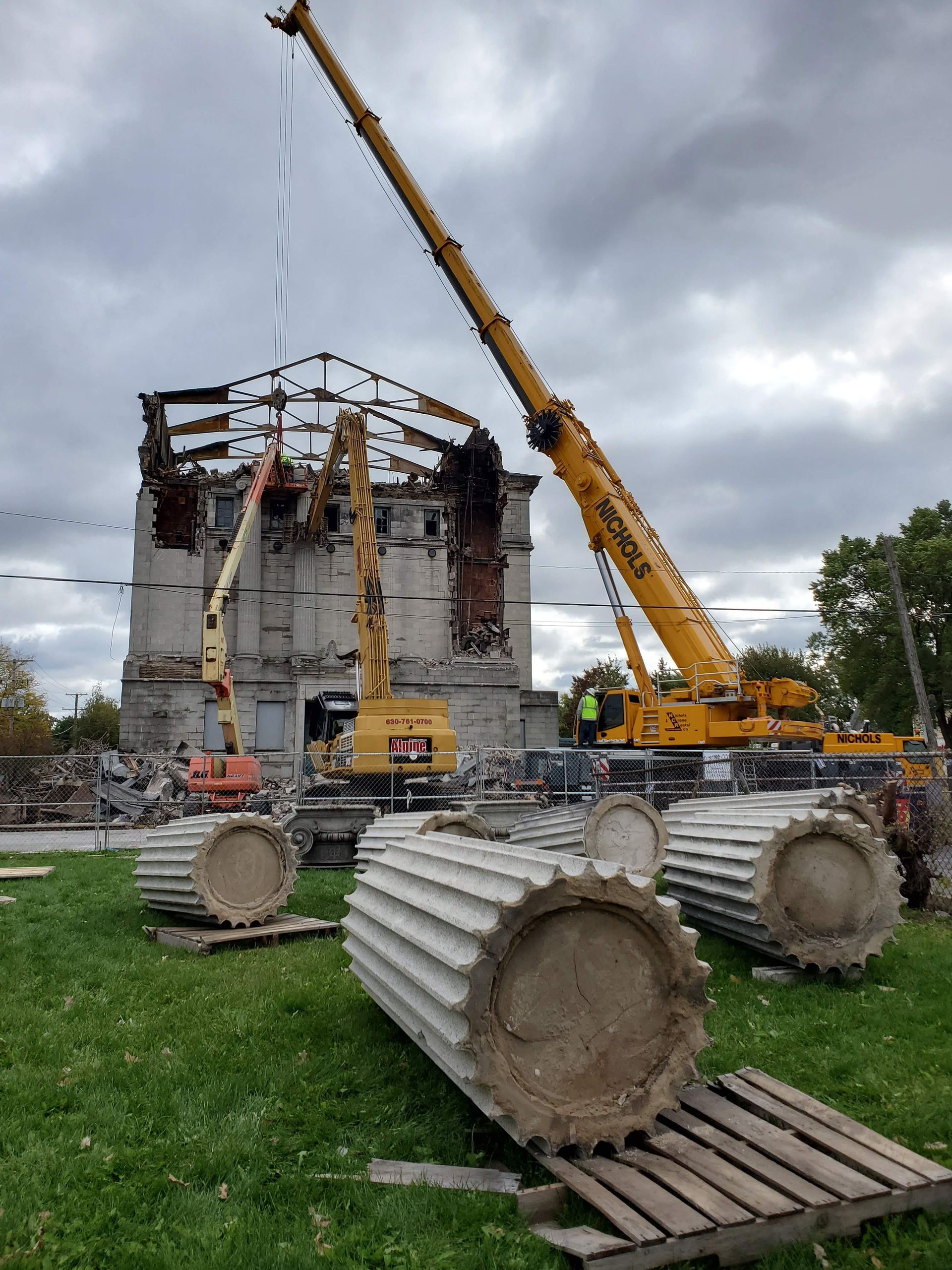
Larger structures add layers of planning that a house rarely needs. An office building, school wing, or industrial plant may sit beside occupied properties or a business that has to stay open during the work. Crews often strip interior finishes, mechanical systems, and hazardous materials first. Then they bring the structure down in a planned sequence using high-reach excavators, shears, or robotic machines.
Utilities can include high-voltage service, gas mains, and fire lines instead of a single meter. Debris volumes are large enough that sorting steel, concrete, and other recyclables on site affects both cost and trucking schedules. Owners also coordinate with architects, engineers, general contractors, and inspectors, so demolition services at this scale involve as much project management as equipment.
When Residential and Commercial Demolition Overlap
The categories blur more often than most owners expect. Under federal rules, the four-unit exemption covers one isolated house. EPA has clarified that it does not extend to multiple houses demolished on one site or to houses removed alongside nonresidential buildings. A builder clearing a row of homes for a new subdivision, or a developer taking down a house for a retail pad, is running a federally regulated project.
Chicago tightens the threshold further, requiring the federal asbestos notification for any residential building with two or more units. Mixed-use buildings, such as storefronts with apartments above, pay the city’s highest environmental fee.
In these cases, residential demolition calls for commercial-grade planning, licensing, and abatement. Alpine approaches this work for home builders, developers, and public agencies the same way it approaches any commercial teardown.
Permits, Insurance, and Safety Requirements
Permits. A house usually needs one municipal permit and a set of utility disconnect letters. A nonresidential project stacks several approvals:
- A demolition permit from the municipality
- In Chicago, a notice of intent to demolish filed with the Department of Public Health
- An asbestos notification filed with Illinois EPA at least 10 working days before work starts
- Lead assessment for any partial teardown
- Engineering sign-off where a party wall is shared
- Street-use or traffic control permits, in many cases
Insurance. Coverage scales with risk. Roughly $1 million in general liability covers most residential jobs. Chicago-area commercial work typically calls for $5 million or more, plus pollution liability and endorsements naming the owner as additional insured.
Safety. Commercial sites run on a site-specific safety plan, crews trained to OSHA 10 and OSHA 30 levels, daily toolbox talks, and competent-person oversight for silica, fall protection, and confined spaces. That level of planning would be overkill on a single-family teardown.
Environmental Hazards and Abatement Requirements
Older commercial buildings often hide asbestos in floor tile, pipe insulation, roofing, and even beneath slabs. The Asbestos National Emission Standards for Hazardous Air Pollutants (NESHAP) call for a thorough inspection before demolition and removal of regulated material before structural work begins. When a survey misses something, the cost lands mid-project. Public change-order records show unforeseen asbestos adding more than half to a demolition contract’s original value.
Lead paint, universal waste, and abandoned storage tanks add to the list on many sites.
Alpine is licensed by the Illinois Department of Public Health as an asbestos removal contractor and handles
asbestos abatement in-house. Keeping inspection, abatement, and demolition with one team helps get hazards priced into the original bid rather than surfacing later as change orders.
How to Choose the Right Demolition Contractor
A low bid can look appealing until the exclusions surface. Before hiring a demolition contractor, owners and general contractors benefit from asking what the price leaves out, including permits, utility disconnects, fencing, and abatement. It also helps to confirm the license class, compare insurance certificates with the owner’s contract, and ask what work is subcontracted.
Experience with comparable buildings matters as well. A firm that handles
selective demolition inside occupied hospitals or airports plans for dust, noise, and access differently than one focused on vacant lots.
Alpine holds a City of Chicago Class A license, the city’s top tier with no cap on project value. It fields all-union crews and has received safety and excellence awards from the
National Demolition Association. Its 100% women-owned DBE and WBE certifications also count toward participation goals on public work.
Partner With Alpine for Your Commercial Demolition Project
Alpine Demolition Services keeps the process straightforward: share the project details, review a thorough estimate with no hidden surprises, and lock in a schedule built around permits and abatement. The result is a cleared site, finished safely and on time. To talk with an experienced demolition contractor, call (630) 761-0700 or
request a bid today.